Introduction
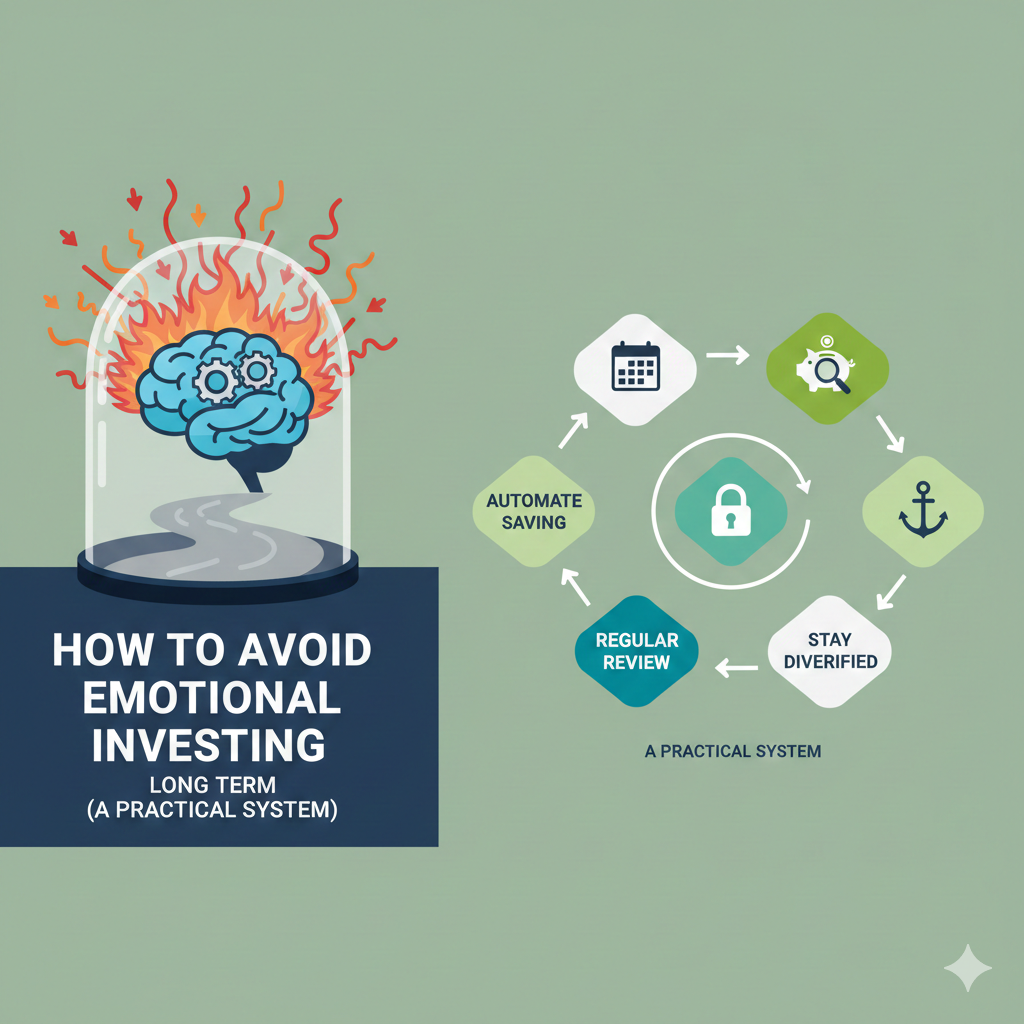
How to Avoid Emotional Investing Long Term (A Practical System) To avoid emotional investing long term, you need systems that reduce decisions during stress—not stronger willpower. Rules, automation, and fewer touchpoints protect investors when fear and greed try to take control.
That approach works because emotions don’t disappear with experience.
Most advice tells investors to “stay calm.” That fails when markets move fast. This article shows how to design a decision environment that prevents emotional mistakes before they happen—so discipline becomes automatic instead of exhausting.
Why Willpower Fails (Even for Experienced Investors)
Emotions Act Faster Than Logic
Under pressure, the brain prioritizes immediate relief over long-term benefit. Knowing the “right” move doesn’t guarantee you’ll make it.
Stress Shrinks Patience
Volatility compresses time horizons. Decisions that made sense over years suddenly feel urgent.
[Expert Warning]
If your plan depends on staying calm, it’s fragile. Plans must work when calm is impossible.

The Core Principle — Reduce Decisions, Not Emotions
Fewer Decisions = Fewer Emotional Errors
Every decision is a chance for bias. Reducing the number of choices reduces mistakes more reliably than improving judgment.
Design for Bad Days
Good systems are built for stress, boredom, and uncertainty—not ideal conditions.
A Practical Anti-Emotion Framework
| System Element | What It Does | Why It Works |
| Written rules | Removes ambiguity | Prevents impulse |
| Scheduled reviews | Limits reactions | Reduces noise |
| Automation | Executes consistently | Bypasses emotion |
| Conservative defaults | Lowers regret | Stabilizes behavior |
| Fewer metrics | Narrows focus | Reduces anxiety |
From real usage patterns, investors who simplify their environment make fewer emotional errors—even without superior knowledge.
Common Emotional Triggers + Practical Fixes
Trigger 1: Constant Price Visibility
Fix: Check portfolios on a fixed schedule (monthly or quarterly).
Trigger 2: Breaking News & Commentary
Fix: Separate information intake from decision windows.
Trigger 3: Short-Term Underperformance
Fix: Evaluate performance over full cycles, not weeks.
[Pro-Tip]
If you don’t need to act today, delay. Time weakens emotion more reliably than reasoning.
Information Gain: Emotional Control Improves Through Inactivity (SERP Gap)
What most guides miss:
Trying to control emotions directly is inefficient.
Key insight:
Emotional investing declines fastest when activity declines, not when motivation increases.
Investors who:
Touch portfolios less
Consume less market noise
Automate execution
…outperform those who try to “be disciplined” while staying highly engaged. In practice, distance beats determination.
UNIQUE SECTION — Practical Insight from Experience
In practical situations, investors who commit to not acting during pre-defined windows (for example, 30 days after a major drop) avoid many irreversible mistakes. Forced pauses convert panic into patience without requiring emotional strength.
Build Your Personal Anti-Emotion Rulebook
Decide in Calm Conditions
Write rules when markets are boring. That’s when judgment is clearest.
Include “Do Nothing” Rules
Explicitly state when you will not act.
Review Rules, Not Prices
During stress, reread your rules before looking at numbers.
[Money-Saving Recommendation]
A written rule that prevents one emotional exit can be worth more than years of optimization.

When Emotional Investing Still Happens (And What to Do)
Even good systems won’t eliminate emotion entirely.
Recognize Early Signals
Tight chest, urgency, constant checking—these signal emotion, not opportunity.
Pause, Then Reassess
Delay action, reduce inputs, and revisit rules.
[Expert Warning]
Acting while emotionally activated is the single most expensive habit investors keep.
Suggested Video:
“How to Remove Emotion From Investing (Systems Over Willpower)”
Educational, behavior-focused, no hype or signals.
FAQ Section
How can I avoid emotional investing long term?
By reducing decisions, automating actions, and following prewritten rules during stress.
Does experience eliminate emotional investing?
No. It reduces frequency, not vulnerability.
Is checking my portfolio daily harmful?
For most people, yes—it increases emotional reactions.
What’s better than willpower in investing?
Systems that remove emotion from execution.
Can automation really help?
Yes. Automation bypasses emotional timing errors.
What if I still feel anxious during downturns?
Anxiety is normal; the goal is preventing it from deciding actions.
Conclusion
Avoiding emotional investing isn’t about becoming fearless—it’s about becoming structured. The investors who succeed long term don’t rely on calm nerves; they rely on fewer decisions, clearer rules, and systems that work when emotions are loud. When structure replaces reaction, consistency becomes natural—and results quietly improve.